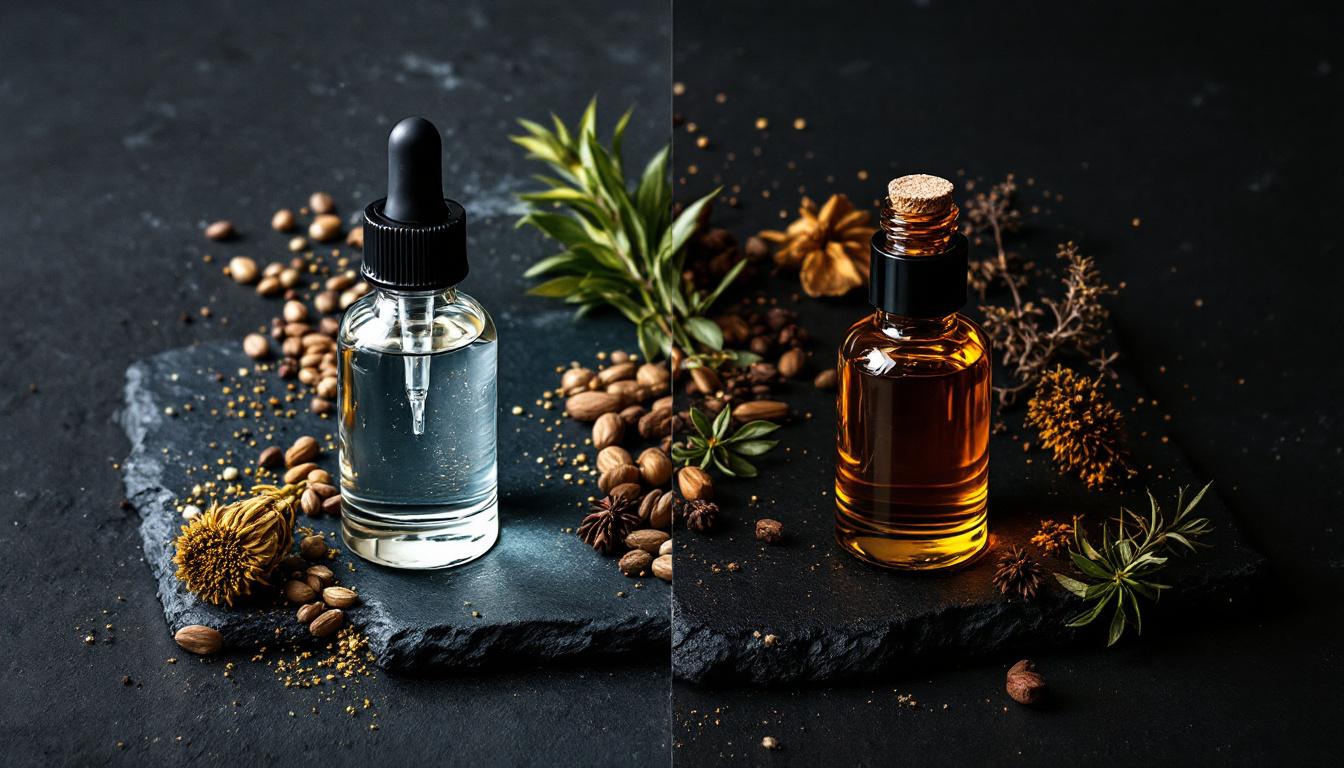
One of the most common questions we get is about ingredients. "Is this made with essential oils or fragrance oils?" People ask it with the assumption that one is clearly better than the other. Natural equals good. Synthetic equals bad. But the reality is much more interesting than that simple division.
Both essential oils and fragrance oils have their place in perfumery. Understanding the difference between them isn't just interesting... it actually changes how you think about fragrance quality.
What Essential Oils Actually Are
Essential oils are extracted directly from plant material. You take rose petals, or jasmine flowers, or lemon peel, and you use steam distillation, solvent extraction, or cold pressing to pull out the aromatic compounds. What you end up with is a concentrated oil that smells like the original plant source.
This sounds straightforward, but there are complications immediately. First, essential oils are incredibly volatile. They evaporate quickly. If you put pure rose essential oil on your skin, it will smell wonderful for maybe 20 minutes, then it's gone. Second, they're expensive. Extracting rose oil requires enormous amounts of rose petals. One kilogram of rose oil needs about four tons of roses.
Third, they're limited. You can only extract from what nature gives you. If you want the scent of a specific type of apple, or coffee, or tobacco, you're extracting from the actual source material. You can't really invent a new scent from essential oils alone. You're always capturing something that already exists.
None of this makes essential oils bad. It just makes them limited in particular ways.
What Fragrance Oils Are
Fragrance oils are synthetic or semi-synthetic blends. They're created in a lab, usually by a professional perfumer, by combining various aromatic chemicals and compounds to create a desired scent profile. Some of these compounds might be derived from natural sources. Some are purely synthetic. The result is a stable, consistent fragrance that won't evaporate as quickly.
Fragrance oils are cheaper to produce than essential oils. They're shelf-stable. They last longer on the skin. And they can recreate scents that don't exist naturally, like the smell of a specific type of wood, or a gourmand scent that combines multiple ingredients in a way nature never does.
The word "synthetic" often gets a bad reputation. But a synthetic fragrance compound is not dangerous just because it's made in a lab. Food flavourings are made the same way. Many medicines are synthetic. Synthetic doesn't automatically mean inferior.
The Blending Question
Here's where it gets interesting. Almost no modern fragrance is made from pure essential oils alone. If it were, it would be incredibly expensive, it would smell raw and earthy, and it would fade almost immediately. Instead, most fragrances... even ones that market themselves as natural... are blends of essential oils and fragrance compounds.
Why? Because they work better together. Essential oils give you authenticity and depth. Fragrance compounds give you stability and complexity. The best fragrances use both, thoughtfully, in proportions that create something beautiful.
At Jam & Bottle, we use both. We choose essential oils where they add something irreplaceable. The rose in No.1 Powder & Petal comes from real rose oil because nothing synthetic captures that particular delicate complexity. But we also use fragrance compounds where they make the composition stronger. The gourmand elements in No.2 Spun & Golden, for instance, come from a blend of natural and synthetic notes that work better together than either would alone.
Cost and Quality
One of the biggest misconceptions is that "all natural" automatically means better quality. This isn't true. A poorly made all-natural fragrance smells worse than a thoughtfully composed blend of natural and synthetic notes. And a cheap fragrance made mostly from fragrance compounds can be inferior to an expensive one that strategically uses essential oils in the right places.
What matters is intention and knowledge. A perfumer who understands materials, who has trained for years, and who cares about their composition will make something beautiful regardless of the specific ingredients they choose. A manufacturer just trying to hit a price point and slap a label on it will make something mediocre, natural or not.
The Longevity Factor
If you're comparing two fragrances and wondering which will last longer, the answer is usually "the one with more fragrance compounds." Pure essential oils fade. That's their nature. Fragrance compounds are designed to be more stable on the skin. This is why a 20-pound bottle of pure essential oil fragrance costs less to produce than a 20-pound bottle of carefully balanced fragrance oil, even though it might smell "nicer" in the first five minutes.
This is also why concentration matters. A fragrance oil at 20% concentration will last much longer than an essential oil at 10%. The concentration determines longevity as much as the type of ingredient.
So Which Is Better?
Neither. The question itself is a false choice. The better question is: What does this specific fragrance do, and does it do it well?
Does it smell beautiful to you? Does it last as long as you need it to? Does it feel authentic? Does the price match the quality? These are the questions that matter. Whether it was made from essential oils, fragrance compounds, or a thoughtful blend of both is far less important than whether the final product is something you love wearing.
Some of the most beloved fragrances in the world use mostly synthetic compounds. Some artisanal indie brands use mostly essential oils and charge premium prices accordingly. The ingredient list doesn't determine quality. The craftsmanship does.
So the next time someone tells you that "essential oil fragrances are real fragrance," you'll know better. Real fragrance is something that was made thoughtfully, from whatever materials serve the composition best. And sometimes, that means the synthetic stuff deserves more credit than it usually gets.